Did you check the UV index today before going out in the sun? It may not be as safe as you think

How much should you rely on the UV index for sun safety? A dermatologist who deals with skin cancer and skin ageing every day explains how to read it wisely
As a fair-skinned sun safety fanatic with a host of dermatologists in her phonebook, going out in the sun when the UV index is high is a complete no for me. Although I’m starting to feel outnumbered given the spike in TikTok influencers advising we do the exact opposite. Social media is awash with videos explaining how to use the index (ranging from 1-11) to gauge the best UV index to tan.
With the exception of impressionable teenagers, who think tan lines look cool, most of us know it’s prudent to either cover up, wear sunscreen or avoid sun exposure in the middle of the day. But some influencers suggest a low UV index means it’s fine to expose your skin, even during these peak times. Even if you’re not chasing a tan, our bodies need sunlight to synthesise vitamin D. Studies show that morning light in our eyes is great for regulating our circadian rhythms, particularly close to sunrise. However, at a time when so many influencers are endorsing extreme sun exposure and demonising SPF use, and with skin cancer rates rising, we can’t ignore the nuances of sun exposure, which we’re here to explore.
Is the UV index a tool that we can genuinely rely on for answers about skin safety and long-term skin health?

The daily UV index is calculated by national meteorological and environmental agencies such as the UK Met Office and is considered a reliable public health tool by the NHS. The ‘UV index today’ score takes sun angle, ozone levels and daily cloud cover into account.
The index essentially shows how long it takes for skin to turn red and burn – the higher the UV index score, the faster skin damage occurs.
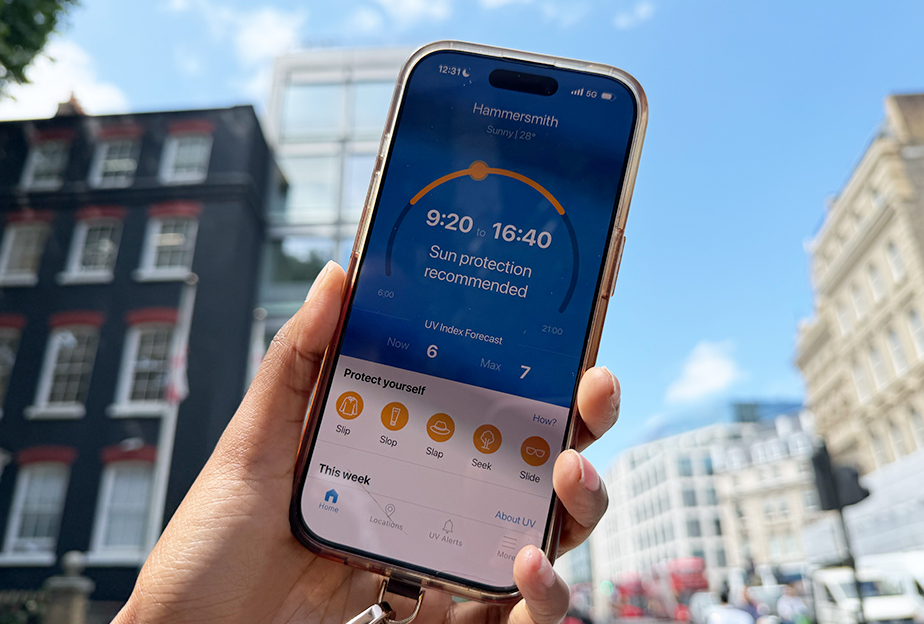
The high UV Index today at Get The Gloss HQ says sun protection is recommended
The UV index tool was developed by Canadian scientists in 1992 and offers a daily single score for your location. However, it wasn’t created with multiple demographics or skin tones in mind. In fact, it was modelled on just one – the Fitzpatrick Type 2 profile, which is a very fair skin tone that shows redness quickly.
So if you have olive skin that tans instead of burns or dark skin that doesn’t show redness clearly, you might not notice skin damage occurring if the UV index is high, and this can put you at risk.
Experts say the UV index gives us some indication of the strength of UVB rays on a given day, but it doesn’t give us the whole picture and there’s far more to consider when it comes to sun safety.
“The index is not personalised, so, for example, a 6 means the same environmental UV intensity whether you have very fair skin or deeply pigmented skin. But the time it takes to burn at will be very different,” says Dr Clare Kiely consultant dermatologist and co-founder of The Skin Diary, a skincare brand specialising in repairing and protecting sun-exposed skin.
Dr Kiely, a skin cancer specialist, sees the effects of cumulative sun exposure on every skin type daily. She points out that the UV index only measures UVB (burning) rays and doesn’t account for UVA (ageing) rays, which are also present during daylight hours and penetrate more deeply into the skin than UVB.
Just because you’re not burning, it doesn’t mean you’re not causing damage. “UVA contributes to pigmentation, oxidative stress, collagen breakdown and photo ageing,” explains Dr Kiely. “But it’s less quick to cause immediate redness.”
Your risk of damage is simply not fully captured by a simple sunburn-risk number like the one the index offers. Particularly as across your lifetime, your skin will be consistently soaking up both UVA and UVB rays.
Kiely explains that she sees more skin cancer cases in older people because in older skin, damage has accumulated. She uses the analogy of a cup and says that over time, with more exposure, the cup fills up. When it’s full, you may have a problem.
“Skin damage depends on how long you are outside, your skin type, your age, your previous UV exposure, your personal or family history of skin cancer, whether you have pigmentation problems such as melasma, which can heighten damage and whether you are near reflective surfaces such as water, which amplify UV rays,” Dr Kiely.
@theskindiary_ukThe UK is experiencing another summer heatwave. Beyond the social media debates and sunscreen misinformation, one fact remains: UV exposure is one of the leading causes of skin cancer. As Dr Clare explains in this episode, long-term studies have consistently shown that regular sunscreen use reduces the risk of both melanoma and non-melanoma skin cancers. Sunscreen isn’t just about preventing premature skin ageing. It’s an important part of protecting your skin health. So wear your SPF. Daily.♬ original sound – theskindiary
In her new book, How To Age, health influencer Liz Earle explains that she deliberately seeks out sunlight at “off-peak” times. Earle has likened lack of sun exposure to smoking in terms of its harmfulness to public health, claiming “burning must always be avoided, but balanced exposure brings wide-ranging benefits”.
Earle argues for mild UVA exposure early in the morning. She claims sun on bare skin outside peak times resets the circadian clocks of fibroblasts – the cells responsible for producing collagen and elastin. Though at peak times or when the UV index is high, she’ll cover up or wear SPF.
Some common sense is needed here. Even if the UV index is low, cumulative sun damage is a concern, and the factor of sunscreen, protective clothing, UV parasol or type of shade you’re using to shield yourself matter.
Being outside for hours, even in the shade, poses a risk of accumulated sun damage because shade doesn’t block all UV radiation. Cancer Research UK says, “up to 50 per cent of UV rays can still reach you through reflected light from surfaces like grass, concrete, and sand”.
Dermatologists advise applying SPF 30 or higher even when you are sitting under trees or umbrellas.
Dr Raj Arora, GP and founder of The Face Bible clinic, says, “People forget that up to 90 per cent of UV can penetrate light cloud, so cloudy doesn’t necessarily mean protected. Even on days when the UV index is below 3, prolonged outdoor exposure can still contribute to DNA damage, premature skin ageing and, over many years, increase skin cancer risk.”
“My concern is that we’re seeing a public health tool being used in the opposite way to how it was intended. Instead of asking ‘do I need protection today?’, some content encourages people to ask ‘is today a good day to tan?’” she says.
Both Dr Arora and Dr Kiely believe the term ‘safe tan’ to be a contradiction. Yes, a little sun exposure outside peak hours of 10 am and 4 pm is considered safe, and generally the UV index will be lower at these times. However, there are days when UV could be within the risk range at these times, and the score it provides doesn’t measure the strength of UVA rays at all. These rays can cause serious cumulative damage across a person’s lifetime.
“A tan is your skin responding to UV-induced DNA damage by producing more melanin,” explains Dr Arora. “It’s a defence mechanism, not a sign that your skin is healthier. Sunlight has benefits for wellbeing, mood and vitamin D. But deliberately trying to tan shouldn’t be confused with healthy sun exposure.”
Experts agree that, with what we now know about the consequences of skin damage, nobody should be intentionally exposing their skin to the sun for prolonged periods, especially when the UV index is above a three. If your skin has changed colour from the sun, that is evidence of UV exposure and biological stress in the skin, even if you have not burned.
Does the UV index offer us any help regarding skin safety? Well, it offers a good jumping-off point, but it’s not an exact science. It’s still worth checking the score to see if it’s above a three because anything over this score means SPF or protective clothing is a must if you want to avoid sun damage.
After this point, it’s worth considering your prior history of sun exposure, asking yourself, ‘is my UVA cup pretty full already?’, considering your skin type and thinking about peak hours, location and how effective your sun protection measures are going to be. Remember that shade is only 50 per cent effective as a deterrent, so a high factor SPF is still worth it.
“The UV Index is an excellent tool when it’s used for what it was designed for: helping us make smarter choices about protecting our skin, not encouraging us to chase the perfect tan,” says Dr Arora, who recommends wearing sunscreen every day, especially on the face, even in the winter months.
When it comes to the health benefits of sun being talked up by influencers, use your common sense. Vitamin D is synthesised by sunlight, but exposing your skin at 7am or taking an affordable vitamin D supplement is much safer. And if tan lines are trending, they’re entirely achievable with self-tan.