Sculptra review: ‘this subtle tweakment dialled my face back a decade’

Move over polynucleotides, Sculptra is the collagen-boosting treatment that puts the spring back in your skin. We tried it
Not so long ago if you wanted noticeably plumper, more lifted skin, your only tweakment options were dermal filler, a thread lift, or surgery. But now, so-called ‘biostimulators’ are having a moment as a more natural alternative to filler.
Polynucelotides – aka ‘salmon sperm facials’ – may have stolen the headlines, but for me, Sculptra is the biostimulating injectable to be reckoned with. It has given my mid-life face back the bounce and padding I’ve not seen in a decade and evened out my skin texture too. Plus, the result is so natural-looking that it all happened without me – or anyone in my family – noticing until I looked back over my six-month ‘pinch test’ before and after pictures (below). The results speak for themselves.
View this post on Instagram
Because you grow your own result; unlike filler, biostimulators don’t add instant volume – you won’t walk out of the clinic looking suddenly different. They will, however, give the fibroblasts that make your collagen (padding) and elastin (springiness) the rocket fuel they need to make them act like they did when your skin was younger, and the effects last several months to two years. You could think of it as a ‘grow-your-own’ facelift – albeit a subtle one.
All aesthetic practitioners I speak to say that they are noticing a degree of ‘filler fatigue’ – clients are asking for it less, in favour of ‘invisible’ tweakments, such as biostimulating skin boosters (think Profhilo) and energy treatments such as lasers and ultrasound (e.g. Sofwave). We also now know that traces of filler can hang around in the face much longer than we’d first thought – up to several years – and even migrate.
Finding the right practitioner for Sculptra was easy – you can search our Gloss Book practitioner directory. I knew Dr Ashwin Soni, a facial plastic surgeon with aesthetics clinics in London and Ascot, by reputation as the man to go to, as he carries out around 100 Sculptra treatments a month. People fly in from around the globe because of his skill with biostimulators, wrinkle relaxers, and blepharoplasties, too. (Want to find a great doctor near you? Here are some guidelines for choosing a new practitioner.
“A lot of my patients – who are usually between 40 and 70 with signs of ageing of the face – want natural-looking results,” he says. “With Sculptra, you can beautifully and very naturally rejuvenate the face without adding too much volume. And I think those days [of inflated volume] are behind us, anyway,” he says.
While people initially have Sculptra for the mid-and-lower face and neck, “as soon as they see those results, they then want it in the hands and the upper arms, abdomen and so on,” reveals Dr Soni. In Brazil, it’s big for buttocks too, he tells me.
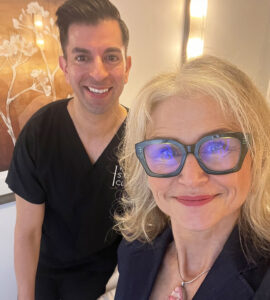
Victoria Woodhall with Dr Ash Soni
Unlike polynucleotides, which come from fish DNA, Sculptra is a plant-based polymer (the generic term is PLLA or Poly-L-lactic acid; Julaine is another newer brand) and is a powder that’s dissolved in sterile water. It’s administered via cannula – Dr Soni used a bit of topical numbing first – and creates what he calls “a huge collagen surge – 67 per cent within 12 weeks. You get a lovely lift and natural collagen stimulation to any part of the face, the neck.”
You can even go up into the hairline “to get a nice little lift to the brows,” he says. I’m in my mid-50s, so of course, I said yes to that.
Sculptra has been around for 25 years and has a strong safety profile. It was originally designed to help AIDs sufferers, who had marked volume loss and gauntness, before quickly entering the aesthetics world where it has gained its age-defining reputation.
I’d heard about side effects of collagen lumps or granulomas, but Dr Soni reassured me that new protocols in the way it’s diluted mean this is no longer an issue. “The 10 per cent risk has gone all the way down to less than 0.04 per cent, and that has been shown in several clinical studies.” He’s never seen a reaction himself. The only side effects are temporary pinpoint bruising and mild swelling and redness.
Ultimately, Sculptra’s long-standing history, decades of impressive before-and-afters on all manner of body parts, and being in the hands of a skilled practitioner, meant I wasn’t worried about trying it.
“The ideal candidate is somebody with a little sagging, especially around the mid and lower face, and a lack of elasticity,” reveals Dr Soni. Age-wise, that’s 30s onwards. “It’s not a prejuvenation treatment, so there’s no point in having it preventatively,” he says. However, perimenopause onwards, when collagen loss accelerates in women due to hormonal changes, is a great time to consider it.
It’s short and sharp, and despite numbing cream and an ice pack afterwards, it does sting when the cannula goes in (I found it less uncomfortable than polynucleotides, where the actual liquid stings too). The entire face and neck were done in around ten minutes, and I had no pain afterwards, although I did have some small cannula bruises.
I had three treatments over four months, four to eight weeks apart. The first was a bigger dose to really boost the collagen-building process – and the price of the treatment depends on how many doses you have. Two to three sessions is average, and the collagen that you make can last up to two years if you keep up an annual single-session maintenance.
As for results, they start to show in six weeks. “And they only get better,” says Dr Soni. I saw peak results at around six months, and now, eight months on, I’m still plump and pillowy with better skin texture, less pigmentation, and a noticeable glow.
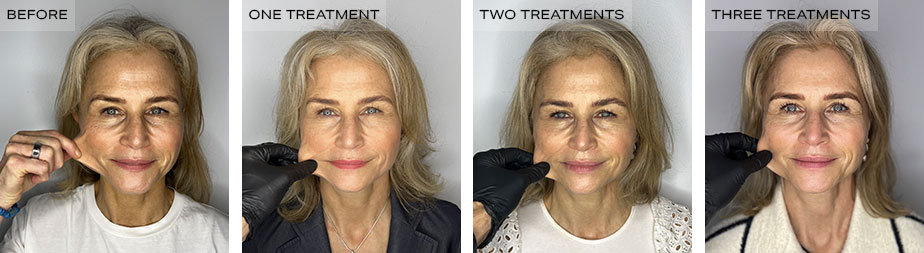
Before and after three treatments of Sculptra
“By 12 to 15 months, the particles of Sculptra are broken down into carbon dioxide and water, which you end up breathing out,” says Dr Soni. This means it lasts longer than polynucleotides, which are said to last a few weeks in the face.
Massaging the face is essential to distribute the product underneath your skin, wherever you’ve had it. “It’s the rule of five” says Dr Soni. “You massage it for five minutes, five times a day, for five days.”
I was also given a kit with a moisturiser, a timer, and optional gua sha to help spread the product around. You can exercise the next day.
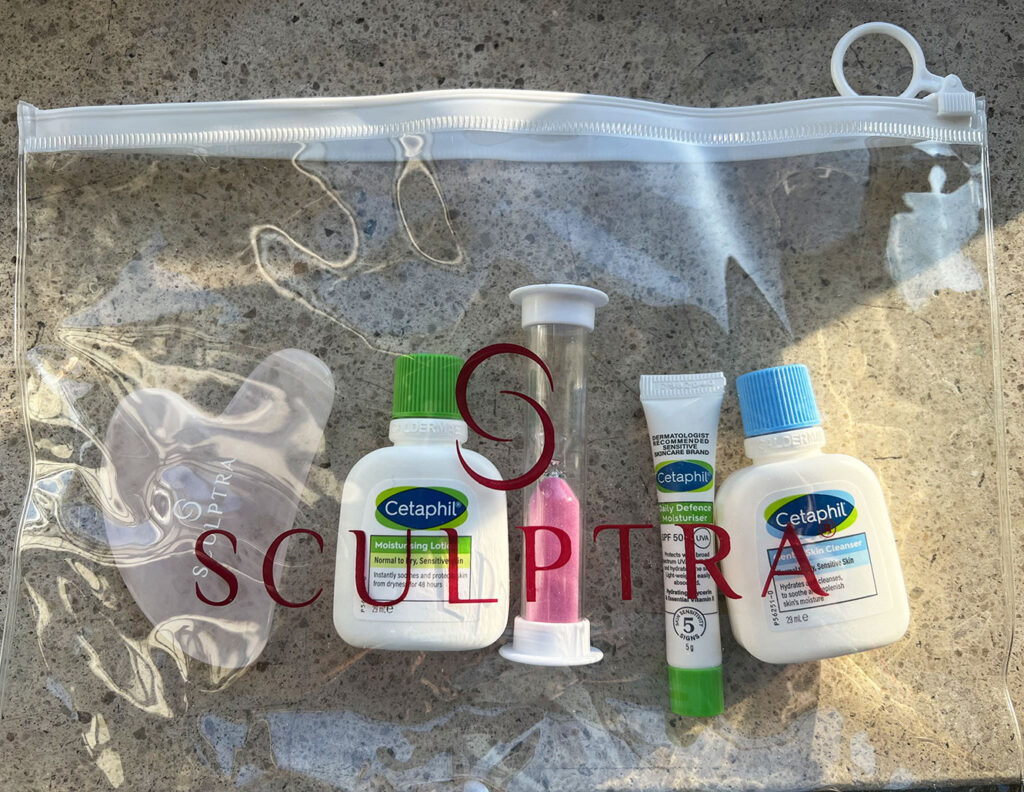
Sculptra treatment aftercare kit
Sculptra is “not a true volumiser,” explains Dr Soni, “but you do get a little bit of volume and lift, based on the collagen stimulation elements of the product.”
Filler is instant, predictable and volumising and will change the shape of your face subtly or dramatically, depending on the look you are after. Sculptra takes time – from six weeks – and the results do depend somewhat on your own collagen-making ability, avoiding collagen thieves such as smoking and sun exposure, and having a collagen-friendly diet.
Dr Soni occasionally uses “a bit of strategic filler” – specifically Restylane – to add extra volume and sculpting if needed, to finesse the result.
Both are biostimulators, mostly done via cannula, and are fully metabolised by the body eventually.
Polynucleotides are more of a regenerative and hydrating treatment, where results last around eight months, after which you need to repeat the course of two treatments. Polynucleotides also treat more delicate areas such as the eye area, the hair, and the lips.
But if it’s volume you are after, Sculptra (as the sculpting name suggests) wins out for collagen stimulation and natural lift with lasting results. Like polynucleotides, it also addresses skin quality, texture, and pigmentation. For me, it’s Sculptra all the way for the face and neck, as the results last longer – so you get more bang for your buck – and you get a lovely lift. However, I’ll still turn to polynucleotides to regenerate those fine lines and dark circles around the eyes.
Sculptra costs from £500 – 750 per session with Dr Ash Soni at the Soni Clinic. Polynucleotides start from £500 per session.