Composite bonding: ‘This drill-free treatment transformed my smile and I’ve never had so many compliments’

Forget dazzling Hollywood smiles, composite bonding is the subtle and pain-free way to even out your teeth and turn back the clock – we were astounded by the results
I’m not a nervous patient at the dentist, but I almost cancelled my appointment for a ‘cosmetic contouring’ smile makeover at The ABC Smile in central London. I’d seen too many people with cosmetically ‘enhanced’ teeth, that simply didn’t look like their own: too white, too bulky, too uniform. Were my own teeth really that bad? They were chipped and worn with age and stress grinding, they were thinner and more translucent than they used to be and they could do with being whiter thanks to all that herbal tea – but they were me.
I reassured myself that I was having a non-invasive treatment that was completely reversible – no needles, no drilling, no filing down to stumps – and if I didn’t like it, there was going back, albeit a few grand poorer.
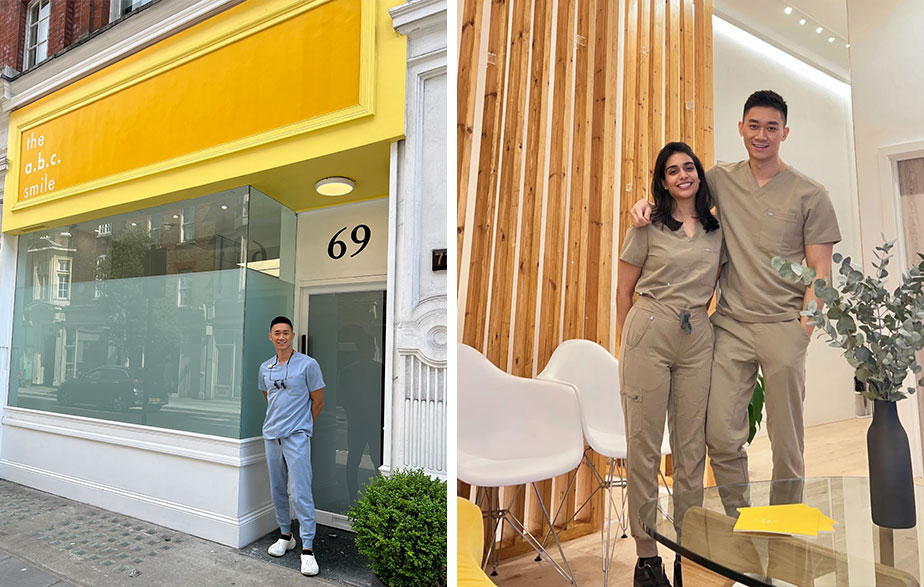
Dr Edward Li and Dr Tania Patel co-founders of The ABC Smile, London
However, after five hours in the chair with clinic founders Dr Edward Li and Dr Tanya Patel, I can attest to this being one of the best confidence-boosting, anti-ageing treatments you can have. After sharing my results on Instagram, I lost track of how many people messaged me to marvel at the results.
Cosmetic contouring – the term Dr Li and Dr Patel use for reshaping the teeth with composite bonding – enhances your own teeth in a way that looks utterly natural but subtly better with improved symmetry and balance. It repairs chips, adds lustre and futureproofs your smile against further incidental damage, supporting the longevity of your teeth.
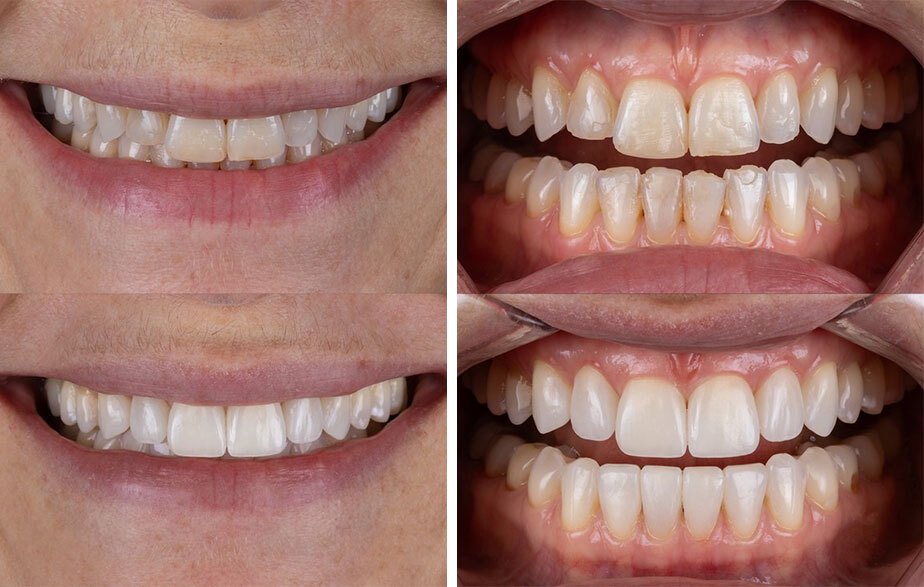
Victoria before and after composite bonding
Just as in aesthetics, there’s a definite move towards undetectable treatments in dentistry. It’s rarer now to see the dazzling white straight teeth of the noughties when blocky veneers – slivers of porcelain overlaid onto filed-down teeth – were all the rage, especially in Hollywood. Even Simon Cowell doesn’t have Simon Cowell teeth anymore.
“People imagine that to get nice smiles, you have to cut your teeth down to then do porcelain veneers,” says Dr Li. But with the recent rise of adult orthodontics, we are more likely to straighten our teeth with Invisalign now than dive straight into veneers for a drastic reshape. “That’s why for us, being able to offer composites to a high aesthetic degree is really important,” he says.
Now quirky smiles, as seen on British actress Aimee Lou Wood, are more likely to be celebrated for their authenticity rather than eradicated for their imperfection. The White Lotus star and former Rimmel London face was nevertheless asked whether her “buck teeth” (her words) were real. She said in an interview with On Demand Entertainment that she was never called on to play Americans because she didn’t look the part: “No Americans have my teeth. They just don’t. I’d have to get veneers.”
Enhancing teeth is real artistry. Dr Li applies up to five layers of bonding, carefully recreating the shades, the colour patterns and the translucency of your own teeth. Dr Patel is the second pair of eyes, suggesting the subtlest of tweaks, ensuring the end result fits the patient’s personality as much as their features.
View this post on Instagram
At my consultation, they promised to preserve the individualities of my smile – the larger, longer teeth at the front, the rounded edges and the gaps. Importantly, my teeth would not look thicker, the bonding would be a fraction of a millimetre thick, and at the edges where the teeth needed strengthening – so I could bite into an apple without chipping, for example – the extra thickness would be hidden imperceptibly at the back of the tooth.
And if I ever found myself under UV light, although I haven’t been clubbing in decades, my new teeth would not glow purple, as can happen with some finishes.
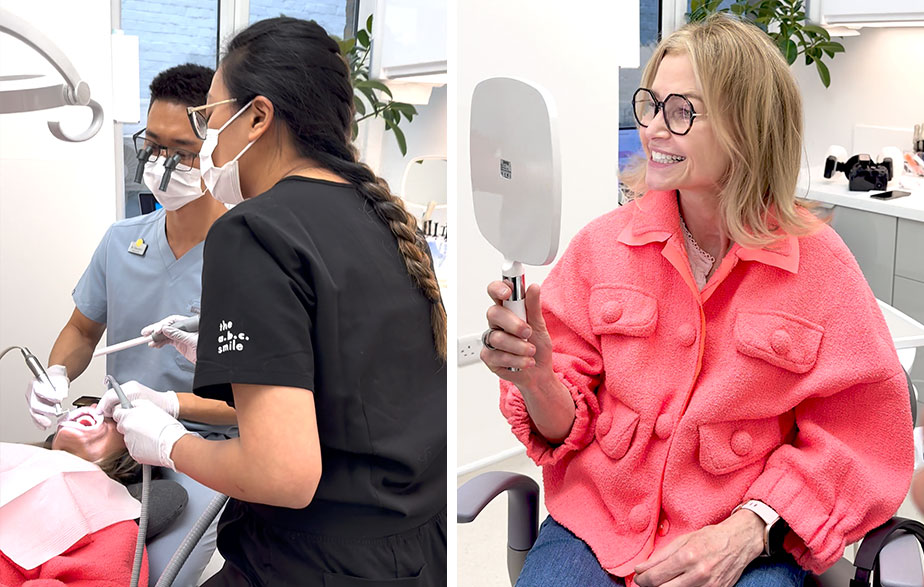
Left: the treatment is painless and relaxing. Right: the big reveal!
I was adamant that I didn’t want bigger teeth as I’d recently seen a friend, whose cosmetic bonding was so bulky it made her lips protrude in a trout pout. “Some people want that,” notes Dr Li. In the same way, some ask for a more obvious or ultra-white aesthetic.
Dentists, too, have their signature styles, which is something to be aware of when you’re choosing your practitioner. One person’s perfect smile is another person’s Rylan. These are definitely questions to ask at any consultation.
I went to The ABC Smile after seeing their results on a similarly nervous friend. She’d seen about seven clinics first before she found the ‘one’. I loved her result and wanted what she had.
“We can make slightly crooked teeth look straighter,” says Dr Li. “We can make uneven edges look symmetrical and we can make slightly darker teeth look slightly lighter.” In my case, they recommended treating the top six teeth and the bottom four.
“We’re going to restore the chipped and worn edges, and provide more balance and symmetry to the side teeth, so that the front two teeth are not quite as dominant,” explained Dr Li. “On the bottom teeth, we will make sure the edges are nice and symmetrical, while bringing out all the natural textures.”
If you have healthy, relatively straight teeth that need a little more evenness, symmetry and signs wear repairing, composites are a good option.

Left: after whitening, before treatment. Right happy ever after
“Both materials get very high aesthetic outcomes – there’s no difference in which one looks better. The main difference is longevity,” explains Dr Li. Composites last around seven years and veneers around 15. Porcelain is harder and so more suitable for a tooth that needs greater support, for example, if it’s been broken in an accident or has large fillings.
Veneers may be better for if you want major changes, says Dr Li. “Let’s say you have quite short teeth or small teeth, and you would like to see more of your teeth when you smile, then we might design that in porcelain. It’s more symmetrical and more controlled for us, because we design everything outside the mouth, and then it’s placed on the teeth.”
Composites, on the other hand, are done in the chair, which Dr Li says is not as accurate for making major changes.
Prepping the tooth for a veneer doesn’t mean filing it down to a stump anymore, he adds. Only a thin layer is removed, but it is an irreversible change, unlike composites.
It’s all done in three to four appointments over about two months. First comes the consultation and hygienist visit, followed by around six weeks of at-home whitening before you return for your bonding treatment. The treatment itself takes a good few hours. My top six took three hours in the morning and bottom four around two-and-a-half. You can split top and bottom over different days.
A couple of weeks later, you return for a review to see if you need any alterations (I didn’t) and to receive any new whitening trays or bite splints to fit your new shape.
Pre-whitening is essential as your composites will be matched to the colour of your natural teeth. The whiteness of the tooth underneath the composite is key. “Because the composite is translucent and thin, the colour of the tooth will largely be determined by on the natural tooth underneath,” says Dr Li.
There’s absolutely no pain as it’s literally a paint job. You lie there, mouth propped open with dental dam, and the only noise is suction and Edward and Tania discussing the finer points of this corner or that gap. I lined up a list of podcasts for the duration, it was all pretty relaxing. I had a loo break after about two hours. At lunchtime, I could eat or drink anything I wanted other than turmeric – this is the only thing that will stain your new teeth in the first few days.
Apart from avoiding turmeric for two days, nothing was off limits. Tania warned that it might take me a week or so to get used to the new mouth-feel of my teeth. But from the start, they looked and felt like mine.
As composites are not as durable as enamel, you’re advised not to bite into really hard things, such as ice or nuts, with your front teeth, or use them to tear open packaging, although crispy foods such as apples and toast are fine. And if you wear a bite guard as I do, being diligent with it to avoid stress damage to is crucial. Abrasive whitening or charcoal toothpastes will create dull-looking scratches, too, so avoid these.
Composites do lose their lustre after a while, so annual non-abrasive special polishing visits are advised.
Unlike your natural teeth, which can soak up stains, composite bonding only acquires surface stains, and these need to be polished off at your hygiene visit (they are not changed by at-home whitening). But you’ll still need to whiten your teeth regularly and you’ll need new trays – your teeth are a new shape after all. Remember that the colour of the teeth underneath shines through the composites. Plus, you want your surrounding teeth to stay white to match.
Cosmetic contouring at The ABC Smile costs from £495 per tooth. My treatment cost £5,500 for contouring 10 teeth. I had extra costs, which not everyone would need: removing existing bonding (£350), hygienist scale and polish (£140), prescription whitening gel (£240), replacement whitening trays (£300), new Michigan Splint for teeth grinding to fit my new shape (£850).
I don’t know why I was so nervous. Cosmetic contouring treatment turned back the clock on my teeth by at least two decades. More than that, it has made them better than they have ever been, with symmetry and evenness that’s just the right side of natural. It’s no wonder this duo has won so many awards. Yes, it’s a hefty investment, but for a transformation that protects and enhances your smile and gives you confidence, it’s game-changing.