LED for hair: we tried the leading caps and helmets claiming to make your hair grow

With more of us looking for hair loss fixes, red light hair caps and helmets are everywhere. What should you invest in and what results can you expect?
The topic we beauty editors are most asked about? LED face masks. But lately we’ve also seen a steady stream of queries about LED hair caps and hats. With increasing numbers of women suffering from hair fall, hormonal hair loss and breakage, it’s hardly surprising that interest in a painless, drug-free, at-home solution is peaking.
LED hair masks use the same skin-calming, cell energy-boosting, collagen-plumping red light technology that you’ll find in an LED face mask. But what can it do for hair and scalp health? Claims range from boosting circulation to awakening dormant follicles to calming scalp inflammation. But while the research is encouraging, it’s still very much in the ‘emerging’ stage, and if you’re planning to invest in an expensive helmet in the hopes of re-growing a luscious mane, note that results may be modest.
Prices range from £199 for a Beauty Pie All Systems Grow cap to £1200 for a Celluma Mystique helmet. Some come with clinical proof and medical clearances, while others are purely cosmetic. Alongside LED light, you will find some devices that use low-level laser beams, and while most hair devices use red LED wavelengths, some also include near-infrared (NIR) ones.
All devices have different protocols, ranging from 10 minutes a day to 30 minutes every three days, which is an important consideration. For this technology to work, you must be able to fit it into your life.
We talked to doctors and manufacturers we trust to tell us the unvarnished truth, and we tried the leading brands ourselves. If you’re looking to invest, here’s what you need to know.
At the very least, your LED cap will help boost circulation and blood flow in the scalp, optimising its health. But a well-designed device with clinical studies to back up its claims will interact with the follicles and stimulate cellular energy. This is thought to make follicles function, repair, and regenerate more efficiently, leading, potentially, to increased hair growth and strength.
“Benefits will be gradual and modest, says cosmetic doctor Jennifer Owens. “Reviews and sham-controlled [the equivalent of placebo-controlled] trials suggest low-level light therapy can improve hair density and thickness in androgenetic (male and female pattern) hair loss, but results depend on device design, dose, and consistent use.”
The thinking is that the light extends the anagen (growth) phase of the hair, so you hold on to your locks for longer. Other types of hair loss respond less well, and in varying degrees, to light therapy.
It’s important to know that no brand has actually done independent clinical trials on its LED hair devices, although many have done in-house trials and consumer tests.

Get the Gloss Editorial Director Victoria Woodhall tries LED hair growth helmets by Currentbody (left) and Nooance Paris (right)
Some devices, such as the Currentbody Hair Growth Helmet, offer just red LED light. Others, such as Celluma have red and near-infrared (a combination you’ll find in most LED face masks). Some, such as the Nooance Pro Hair Helmet, add in cold laser (aka LLLT, aka low-level laser therapy). So what is best?
“The strongest and most plentiful evidence for direct follicle support and boosted hair growth is for red light, with wavelengths between 630-680 nanometres (nm),” says Tracy May from iSmart Developments, who manufacture LED devices for well-known brands, and their own, FaceLite. The most reliable wavelength for modest hair improvements is 650nm, which has been used in most of the research studies on androgenetic alopecia.
The jury is out on whether it’s helpful to combine red light with near-infrared (NIR) light when it comes to hair support. “NIR may encourage deeper light penetration, better microcirculation, anti-inflammatory effects and follicle support, but we don’t have a lot of evidence that a combination is better than red light alone.”
As for low-level laser beams versus LED light, there is no clear consensus over which is best.
LLLT or low-level laser therapy uses cold lasers to emit the same wavelengths that LEDs do, but instead of it being diffuse light (non-coherent) these beams are concentrated and focused (coherent). You’ll find them in professional, often very expensive devices, used by some trichologists such as ‘Hair Whisperer’ Ricardo Vila Nova, who looked after Get The Gloss’ Victoria Woodhall’s hair restoration, using a laser device alongside microneedling and PRP.
The original clinical studies on light therapy, or ‘photobiomodulation’ used laser, not LED, so some claim that laser is the only form of therapeutic light that works.
However, says May, “light quickly becomes less coherent once inside the skin, so claims of ‘deeper, more focused’ therapy don’t carry that much meaning.” The current thinking in clinical circles, she says, is that the correct wavelength + correct dose + correct scalp delivery matter more than whether you use lasers or LEDS.”
In other words: LLLT and LED light can be similarly powerful, provided you use a correctly-designed device with FDA Class II medical clearance, such as the Celluma Mystique.
It’s thought that red light therapy may produce modest regrowth by supporting sluggish follicles, although “proof is often overestimated in advertising,” says May. It certainly cannot revive follicles that are destroyed or indefinitely dormant, for example, if you have scarring alopecia.
The main proposed way it works is by prolonging the growth phase of your hair. This particularly appears to be the case for people with male and female pattern hair loss. Increased hair density, slowed-down follicle thinning and reduced shedding have all been noted.
If you have telogen effluvium, alopecia areata, and stress/inflammatory shedding, LED hair devices may support hair growth by dampening inflammation, although the evidence is weaker, says May.
For best results, she says, your helmet should be used early in cases of mild-to-moderate thinning, where follicles are still alive but weakened. “The most important factor is treatment consistency over time,” adds Celluma’s founder, Patrick Johnson.
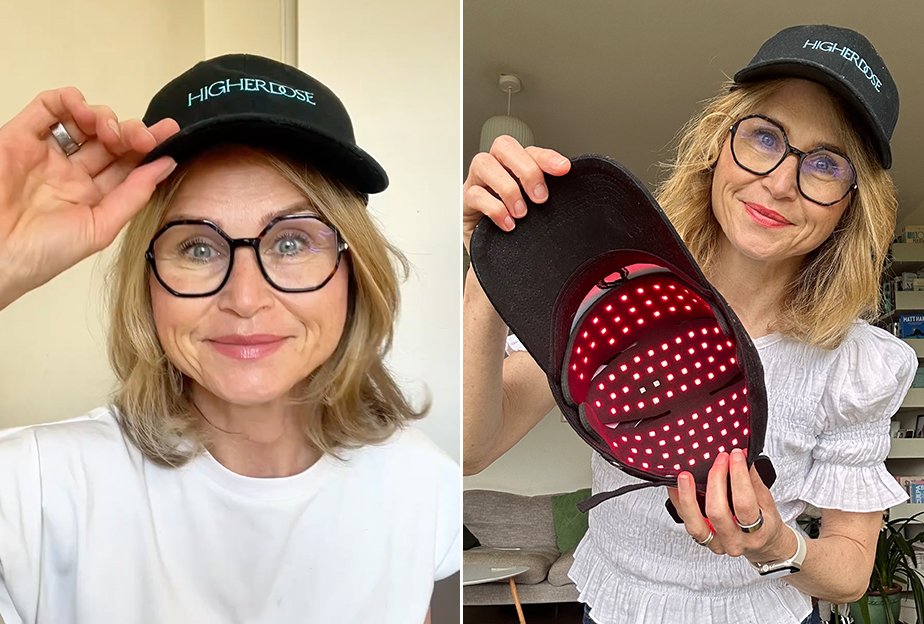
Red light baseball caps emit no noticeable glow for hair regeneration on-the-go. Editorial director Victoria Woodhall tries Higherdose (left) and Bon Charge (right)
Using a red light device alongside a hair growth therapy such as Minoxidil or PRP would be the best way of using your cap, suggests Owens.
Hair loss is multifactorial, she says, so the best results usually come from assessing things that may be driving it, such as “hormones, nutrition, inflammation, stress, scalp health and certain counterproductive topical treatments.” Red light therapy should be one supportive part of a broader plan, she feels.
A decent LED hair device will have FDA Class II medical approval (or FDA Class II medical clearance), which means it’s effective enough for both home and clinical settings and complies with strict regulatory standards. And while it doesn’t actually mean there’s independent clinical proof for any hair growth claims, it usually has, says May, “at least some supporting clinical data”.
You should also make sure your device mentions specific clearance for the treatment of hair loss: general FDA approval does not mean the device is proven to work for every condition LED is purported to treat. In our list below, the Celluma, Nooance, Hairmax, Bon Charge and Currentbody devices have both FDA Class II medical approval and clearance for the treatment of hair loss.
This doesn’t mean devices without FDA clearance are bad, says May. “If it’s well-designed, delivers adequate energy and uses evidence-based red and near-infrared wavelengths, it may well stimulate follicles provided it’s used consistently.”
Cosmetic physician Dr Sophie Shotter agrees that in practice, a baseball-cap style device that someone wears faithfully for a year, “may well outperform a bulkier ‘gold standard’ helmet that ends up abandoned in a cupboard after two weeks.” She feels compliance is up there with the right technical specs when choosing an effective device..
Johnson, whose Celluma devices are used by doctors and dermatologists, advises to look for a clear indication of the dose. “Anything between two and ten joules per square centimetre, and ideally 6j/cm2, is good,” he says, as this is the “evidence-based therapeutic dose.” However, May points out that the right dose for hair growth hasn’t in fact been independently determined.
Usage recommendations will differ depending on the power density, proximity to the scalp, choice of wavelengths and more, so always stick to the instructions, whether you’re looking at 30 minutes three times weekly or 10 minutes a day.
Either way, success involves dogged, long-time use: “Hair growth cycles are slow, so visible changes are typically assessed over months rather than weeks,” warns Johnson.
Potentially, yes: too high a dose, or too much heat, can hamper hair growth, says May, which is why treatment duration and power density matter. “But mainstream FDA-cleared home devices are generally low-risk when used as directed.”
You could, but don’t expect too much. “The issue is not just fit and design,” says Owens. “The design needs to take into account that the light must get past hair, so the evidence for hair loss is much stronger for scalp-specific devices than for repurposing facial devices, even where wavelengths look similar.”
These are our top expert-selected and award-winning LED hair devices.

The doctor-approved hair and face mask
Celluma Mystique, £1200 [out in July]
The first device to treat facial skin and hair loss simultaneously, this is a lot more clinically sound than the whimsical name would have you believe. Approved as an FDA Class II medical device, it has clearances for treating hair loss, acne and skin ageing. Mouldable, it fits snugly around every face and scalp. There’s an option to pulse-deliver the light (red and NIR for the scalp and face), which experts agree improves light absorption.
Usage: Minimum 3x 30 mins per week for 12-16 weeks.
Buy now
The laser-powered hair growth booster
Hairmax Laserband 41 Comfortflex, £599.99
The original FDA-cleared Class II medical device for treating androgenetic alopecia is one you push back onto your scalp like a hair band. It has 42 teeth that emit red low-level laser energy, not LED. This, they say, along with the fact that the teeth directly touch the scalp, stimulates follicles more efficiently and promises to leave you with significant hair re-growth and stronger hair.
Usage: 3x 3 mins per week for 3 months.
Buy now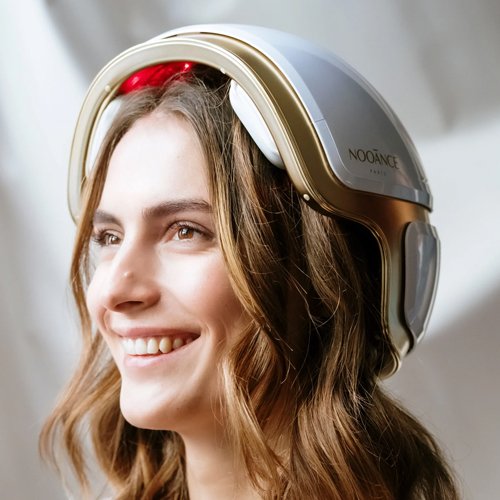
The double-duty pro favourite
Nooance Paris The Professional LED & Laser Hair Helmet, £950
A favourite of Dr Sophie Shotter, this helmet holds FDA Class II medical device clearance for use in the treatment of hair loss. It combines red LED and low-level laser. It’s easy to wear and control with a console, and has a follicle-stimulating pulse mode. Watch out – there’s also a cheaper ‘Beauty’ model, that looks identical but doesn’t have FDA medical clearance.
Usage: 25 mins every other day for 2 months.
Buy now
The multi-award winning helmet
Currentbody LED Hair Growth Helmet, £649.99
This has seven international awards to its name and FDA Class II medical clearance for the treatment of hair loss. Endorsed by hairstylists and hair medics, it has built-in Bluetooth headphones so you never have to switch off, even when you’re busy boosting your follicles.
Usage: 10 mins per day for 16 weeks.
Buy now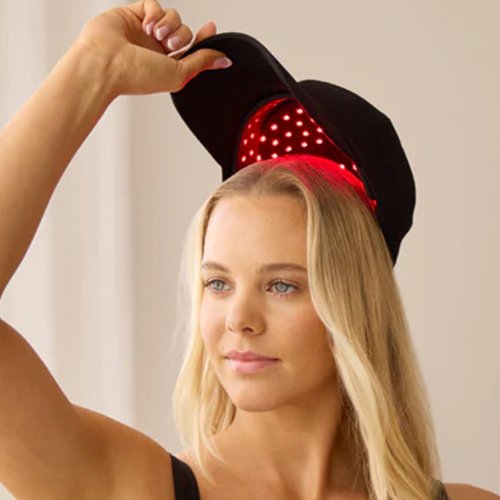
The award-winning LED hat
Bon Charge Red Light Cap, £349
A winner in the 2025 Get the Gloss Beauty Awards, the black baseball-style cap, delivering red light therapy at 650nm, is stylish and good value when you consider is has Class II medical approval and clearance for hair loss treatment. Unlike the bulkier helmets, it’s cordless and has no red glow to give the game away. You can wear it out and about with no one knowing you’re treating your scalp. The cap has good coverage with 125 red light diodes.
Usage: 10 mins per day for 12-24 weeks.
Buy now
The rechargeable follicle fortifier
Higherdose Red Light Hat, £449
Cordless and rechargeable, this deploys 650nm red light – the best-studied wavelength for hair support – via 120 diodes. The company left out NIR, they say, for lack of evidence. It has no FDA medical device or hair loss clearances (the original LED technology is FDA cleared, not this device), but slapping it on is so easy you’ll probably stick to the programme – essential for increasing blood flow in the scalp.
Usage: 10 mins per day for 16 weeks.
Buy now