Perimenopause can hit harder if you have ADHD. This menopause doctor has seen it and knows what helps
If you’re in your late thirties or forties and suddenly you’re forgetting words mid-sentence, overwhelm seems to be your default mode, and your once-reliable coping strategies are crumbling, you might be living through a perfect storm: not just perimenopause, not just ADHD, but both, colliding.
I see this pattern regularly in my clinical practice as a women’s health doctor specialising in perimenopause and menopause. And I know first-hand and from my clinic how bewildering it can feel before you understand what’s actually going on.
Why perimenopause hits harder when you have ADHD
During perimenopause, oestrogen levels stop following their usual rhythm and become erratic. This matters enormously for anyone with ADHD, because oestrogen plays a key role in regulating dopamine, the neurotransmitter central to focus, motivation, and emotional regulation. People with ADHD are already working with lower baseline dopamine. When oestrogen drops, that deficit deepens and ADHD becomes significantly harder to manage, often for the first time. The result is not a straightforward worsening of perimenopause.
Not every woman with ADHD will have a harder perimenopause, but those who haven’t built adequate support around their ADHD are at greater risk. The earlier you understand what’s happening, the more you can do about it.
There’s another layer here, too: the historic gender gap in ADHD diagnosis. For decades, ADHD research was conducted almost entirely in boys and men. Girls learned to mask to compensate, through organisation, people-pleasing, and sheer effort. Many went undiagnosed and were told instead that they had anxiety or depression. That masking can hold for years, even decades. But perimenopause, with its hormonal turbulence and cognitive load, makes it unsustainable. For many women, it’s in their 40s that the mask finally slips and an ADHD diagnosis follows. It’s not that ADHD has suddenly appeared; it’s that the scaffolding that held it together has given way.
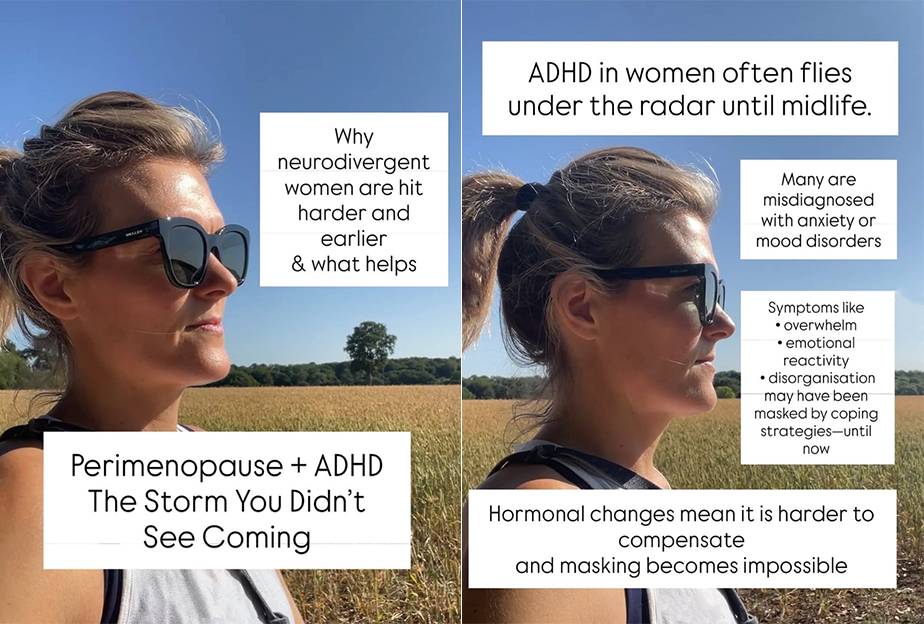
Image: Instagram @themenopausemedic
Signs that perimenopause and ADHD may be colliding
- Emotional dysregulation that feels disproportionate: snapping at small things, crying unexpectedly, struggling to recover from minor setbacks. ADHD already affects emotional regulation. Fluctuating oestrogen amplifies it further.
- Disorganisation that’s new, or worse than before. If structure and routine previously kept things running smoothly, their collapse is a clue. The coping strategies that once compensated for ADHD stop working when the hormonal foundation shifts.
- Word-finding difficulties, brain fog, and poor working memory. These are directly influenced by oestrogen. When levels drop, cognitive changes are often among the first things women notice.
- Energy crashes that don’t make sense. Not just tiredness, but a dysregulation of the nervous system and metabolism that feels like hitting a wall mid-afternoon, or being unable to recover after poor sleep.
- Sensory overwhelm: noise, light, and stimulation that once felt manageable may become genuinely hard to tolerate. This combination of ADHD, sensory sensitivity and hormonal nervous system changes can be particularly disruptive.
Perimenopause and ADHD – what actually helps
The key is treating both simultaneously, not one in isolation.
6 things you can do now to manage hormones in perimenopause
- Track your cycle. Apps such as Clue or Natural Cycles can help, as they allow you to map your symptoms against oestrogen dips, which is validating and useful for clinical conversations.
- Consider HRT. Hormone replacement therapy, where appropriate, can be genuinely transformative for ADHD-related symptoms because restoring oestrogen stability helps restore dopamine regulation. Transdermal oestrogen (patches or gel) is generally preferred. HRT does not clash with ADHD medication, but both may need adjusting as hormone levels stabilise. Always do this in conversation with prescribing doctors.
- Wind down for sleep. Sleep is non-negotiable: oestrogen and progesterone both influence sleep architecture, and ADHD already makes it harder to switch off. Prioritise a consistent wind-down routine, limit screens before bed, and consider whether progesterone (which has a natural sedative effect) might help as part of your HRT.
- Eat protein at every meal. This supports dopamine synthesis and blood sugar stability, which helps with both energy crashes and mood.
- Take key nutrients and supplements. Ensuring adequate magnesium, omega-3, vitamin D and iron can help with both ADHD and hormonal health.
- Move regularly. Regular movement boosts dopamine and noradrenaline naturally, making it one of the most effective lifestyle tools available. My advice is to do what feels good for you, not necessarily what everyone else is doing or telling you to do.
5 things you can do now to manage ADHD in perimenopause
- Use structure strategies. External structure becomes essential when internal executive function is depleted. Strategies like time-blocking, written lists, phone reminders, and body-doubling (working alongside other people, IRL or virtually, to increase productivity and accountability) can all help.
- Explore diagnosis. If you’re not already diagnosed with ADHD and want to go down that route, exploring diagnosis, the NHS Right to Choose pathway gives you access to ADHD assessment and, where appropriate, medication via the NHS.
- Talk to your ADHD medication prescriber. Many women do notice their ADHD medication feels less effective in the days before a period, when oestrogen is at its lowest and the same principle applies in perimenopause, when oestrogen fluctuates over a prolonged period until post-menopause. This is worth raising with whoever prescribes your medication, as dose adjustments may be needed.
- Reduce sensory input to help balance your nervous system. Reducing sensory input during high-overwhelm periods isn’t avoidance. Quieter environments, noise-cancelling headphones and fewer competing demands can help with nervous system regulation.
- Long exhales. Breathwork, particularly techniques that extend the exhale (such as 4-7-8 breathing or box breathing), activates the parasympathetic nervous system and can be genuinely helpful for both the anxiety and the dysregulation that accompany this combination.
Remember – you are not broken
You are in hormonal chaos, navigating a nervous system that was already wired differently. Understanding that is not a reason to feel hopeless. But it is a reason to get the right support. With the right combination of hormonal and ADHD-specific tools, this doesn’t have to be the storm it feels like right now.
If you need help finding calm in the chaos or planning a strategy that will work specifically for you, then please don’t hesitate to get in touch. My team and I would love to help.
Find out more about how to work with Dr Barton via The Gloss Book now
About the author
Dr Fionnuala Barton, Menopause Doctor
Dr Fionnuala Barton is a menopause doctor on a mission to empower midlife women...
View Profile