Peptide injections are everywhere – but here’s what doctors want you to know

They promise everything from better skin to faster recovery to improved longevity but are peptide injections too good to be true? And – more importantly – are they even legal?
From red carpet regulars to biohacking enthusiasts to TikTok influencers, everyone’s talking about peptide injections. Promising everything from improved skin, faster muscle recovery, enhanced metabolism, and anti-ageing benefits, they straddle wellness, aesthetics and experimental medicine. Jennifer Aniston and Gwyneth Paltrow are among the celebrities who rave about them.
But while their rise may feel sudden, the reality is more complicated. In the UK, peptide injections occupy a grey area—medically intriguing but far from straightforward in terms of safety and regulation. So, what are they, who’s using them, and, if you’re interested in longevity, is it worth finding a doctor who offers them?
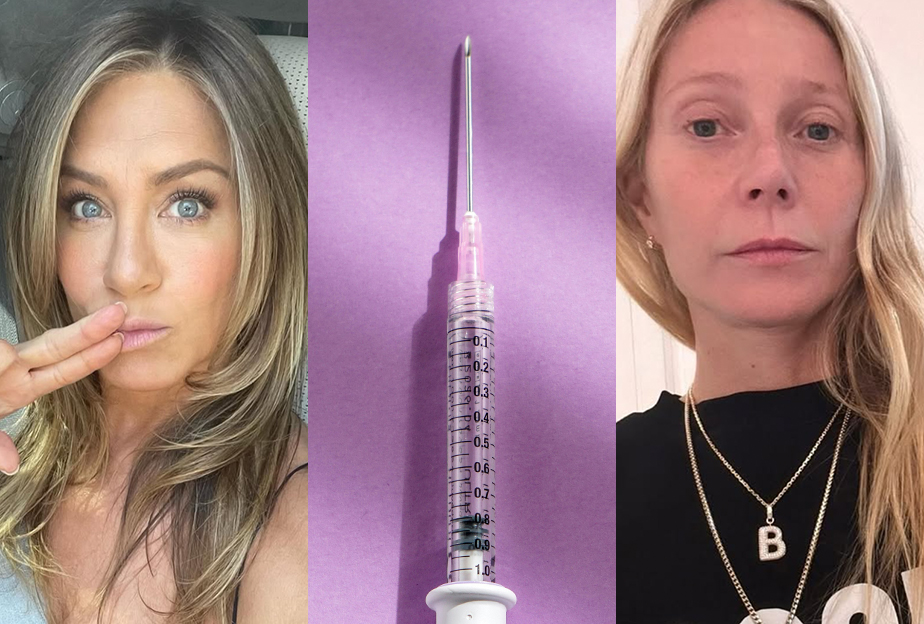
Peptide jab fans Jennifer Aniston (left) and Gywneth Paltrow (Images (left to right): Instagram @jenniferaniston, Unsplash, Instagram @gwynethpaltrow)
Peptides are short chains of amino acids, the building blocks of proteins. They occur naturally in the body and play crucial roles in processes such as tissue repair, collagen signalling, metabolism, hormone release, and inflammation regulation.
“They work by binding to receptors or influencing biological pathways,” explains Dr Sophie Shotter, aesthetic doctor, founder of Illuminate Skin Clinic, and president of the British College of Aesthetic Medicine. “Some peptide medicines are well-studied and licensed; many promoted in wellness circles remain experimental or unapproved.” One example is GLP-1, the hormone targeted by weight-loss drugs, which signals fullness to the brain and helps regulate blood sugar. Other peptides may stimulate collagen production, support muscle repair, or influence sleep and hormone balance. Peptide injections deliver these signals directly.
They are typically injected in your stomach, thigh or upper arm, as these are areas with fatty tissue. People tend to rotate the injection site to avoid bruising. Note that skin-boosting peptide jabs are administered in this way too (they’re different from facial injectables such as Botox which are applied – you’ve guessed it – to the face). One exception is peptide injections for injury repair – the clinician may apply them directly to the area that’s injured.
“I often describe them as WhatsApp messages sent between cells, helping different parts of the body communicate more efficiently and quickly,” says Dr Ahmed El Muntasar, GP and owner of The Aesthetics Doctor. “Peptide injections deliver these signalling molecules directly into the body to help stimulate certain biological functions.” The appeal lies in this targeted approach: rather than a blanket supplement, peptides are marketed as precision tools for optimising how your body functions.
Peptides are promoted for skin rejuvenation, muscle growth, fat loss, injury repair, sleep optimisation, inflammation reduction and longevity. “Some peptide-based medications, such as GLP-1 receptor agonists like Ozempic or Mounjaro, are supported by large-scale human trials,” says Dr Jennifer Owens, founder of The Glow Clinic in Ireland, who is currently in residency at Harley Street’s Reborne Longevity. “Outside of these, most injectable peptides discussed online have very limited human data. Evidence often comes from lab or animal studies rather than robust clinical trials.”
Two cultural shifts have collided: the rise of longevity culture and the normalisation of injections. Treatments like GLP-1 weight-loss drugs and vitamin injections have made needles far more mainstream. Add in celebrity endorsement, and it’s easy to see why interest has surged. “Peptides are often marketed as part of the biohacking or longevity trend, and while that can sound appealing, it is important not to be led by hype,” cautions Dr El Muntasar. “If something sounds too good to be true, it usually is, particularly in an area that is not yet well regulated.”
Jennifer Aniston has been one of the most vocal advocates, declaring peptide injections “the future” of skincare, while Gwyneth Paltrow has described them as “one of my biggest wellness tools.” Importantly, these treatments are typically carried out under medical supervision in US clinics, where certain peptides can be prescribed.
In the UK, the conversation is newer but growing. Last year, beauty entrepreneur Trinny Woodall said she injects peptides four times a week: “I get them from the US to help with skin, hair, energy and for the longevity of my body as a whole.”
Nutritionist and model Rose Ferguson shared her entire peptide routine on Instagram, including Ipamorelin for recovery and sleep quality, GHK-Cu for cellular rejuvenation, SS-31 for reducing oxidative stress, and BPC-157 for tissue repair and inflammation regulation. “I am enjoying trying them out,” she wrote. “But they are not the foundation. They sit on top of sleep, stable blood sugar, good nutrition, strength training, and nervous system regulation.”
View this post on Instagram
But Dr Shotter urges extreme caution: “Not one of these peptides is licensed in the UK for aesthetic or wellness use,” she says. “If a patient asked me about them, I would say that the burden of proof has not caught up with the marketing for most of these compounds, and I would be very wary of presenting them as evidence-based anti-ageing treatments.”
Most peptide injections are not licensed medicines in the UK, meaning they have not been approved by the MHRA (Medicines and Healthcare products Regulatory Agency) for general use. However, some doctors may prescribe or administer peptides off-label in private clinics. This means they are using them outside of their licensed indication, based on clinical judgement.
Yes, but mostly in private longevity or functional medicine clinics, often in London. These clinics tend to offer peptides as part of a wider health optimisation plan, which may include blood testing, hormone analysis and lifestyle interventions. “If you are genuinely interested in exploring this arena, then go and see a doctor who practises longevity medicine, like Dr Tam Lewis at Reborne Longevity, who can clearly advise you on safety and the role that peptides play,” suggests Dr Shotter.
Safety depends heavily on how and where they are used. In a medical setting, certain peptides may be used responsibly. But the broader market is far less controlled. “At best, they’re likely to be a waste of money. At worst, they can be genuinely unsafe,” says Dr Owens. “The concern isn’t just the peptide itself – it’s the lack of regulation. There’s no reliable way to verify what’s actually in the product, the dosing, sterility, or how it may affect you. Without proper medical oversight, the risk far outweighs any potential benefit based on what we currently know.”
They are not available on the NHS, and private fees typically range from £200–£500 for your initial consultation, with individual treatments anywhere between £150–£500. A full programme can cost thousands per year.
In short: no. Online, peptides are often sold as “research chemicals”, meaning they are not approved for human use. Products may be mislabelled, impure or incorrectly dosed. This is the wild West of TikTok “peptide stacks”, DIY injections and influencers showing off their “peptide fridges”.
“The risks are not theoretical,” says Dr Shotter. “When people buy injectable products online, they often have no reliable way to verify what’s actually in the vial, whether the product was manufactured to sterile standards, whether the dosing is accurate, or whether the supplier is using “research use only” labelling to sidestep accountability. Even when a compound is real, that does not mean it is appropriate, safe or legal for self-injection.”
That depends on your expectations and your access to a qualified practitioner. In a reputable clinic, certain peptide therapies may offer benefits as part of a broader, personalised health plan. But for now, the evidence is mixed, regulation is limited, and outcomes are highly variable. Under medical supervision, they may have a place. At home, they carry significant risks.
Dr Shotter’s advice? “Slow down and ask much better questions before you buy into the promise,” she says. “Is this an approved medicine or an experimental compound being marketed as lifestyle medicine? What good-quality human data support the benefits being claimed? Who is prescribing it, who is accountable for monitoring me, and what happens if something goes wrong? Where was it made, and how is sterility and batch quality being assured? And is this really the best use of my money, or am I overlooking lower-risk, better-supported strategies?”
As ever, the fundamentals (sleep, stress, nutrition, exercise) still matter most. And while peptides may one day become part of mainstream medicine, for now, cautious curiosity, rather than blind optimism, is the smartest approach.