Gloss Boss Leslie Kenny: “At 39 I was told only had five years of good health left”

After overcoming chronic health problems, Leslie Kenny founded a longevity supplement backed by top scientists. Here’s how she did it – and why she’s always doing headstands
It was a devastating doctor’s diagnosis two decades ago that set Leslie Kenny, then a stressed-out CEO of an online matchmaking business, on the path to a very different life. Today she’s founder of both Primeadine, a scientifically-proven longevity supplement, and the Oxford Longevity Project, a non-profit organisation led by lauded academics and medics, that aims to help everyone better manage ageing.
When she was 39, Kenny developed trouble with her hands – turning doorknobs and using scissors had become weirdly difficult. She’d also been trying to get pregnant for eight years and was not having any luck with IVF. Her doctor dropped a bombshell. She had three autoimmune diseases: lupus, rheumatoid arthritis and Hashimoto’s.
“The doctor said to me, ‘You’ve got five good years left’. As in, five years of good health,” says Kenny, now 60. “She also said, ‘You can forget about having a baby’. I was in the middle of my fifth round of IVF and that was very hard to process.”
And so began 20 years of trying everything she could to rewrite that dire forecast by reducing inflammation, which is at the heart of most chronic illnesses. She made major lifestyle changes, including fasting and removing sugar, gluten and dairy from her diet, reducing stress (she sold her business) and prioritising sleep. Back home in the US (she is half American, half Taiwanese) she had a cutting-edge blood transfusion treatment to help reset the immune system.
Just six months later, Kenny, who lives in Oxford, was a new person, in remission from all three conditions. She conceived naturally at the age of 43 (her daughter is now 17, she also has an adopted daughter, 20). And, according to the Glycanage blood test that checks inflammation markers, she now has a biological age of 21. Having spent time in her orbit, I’m unsurprised to hear this: she’s endlessly energetic and upbeat, moves at the speed of light, and has enviably naturally dark, thick glossy hair with zero greys. Sixty looks extremely good on her.

60 and definitely not out: Leslie Kenny overhauled her health (image: Instagram @oxfordhealthspan)
She’s a very good advert for the unforgettably-named spermidine: the wonder ingredient in Primeadine, which she came across via her Oxford circle of academics and researchers, and she credits with helping with that youthful biological age.
Spermidine is a powerful molecule found in the ‘endosperm’ of seeds that provides sustenance for the next generation of plants. As a supplement, it encourages autophagy, the process of cell renewal by clearing out ‘zombie’ cells that can cause inflammation and thus slowing down cellular ageing. (Fasting is another way of kickstarting this.) Spermidine is not currently mainstream but biohackers rave about it – fans include US neuroscientist and podcaster Andrew Huberman, genetics professor and scientist Dr David Sinclair, Dr Sophie Shotter, Liz Earle and Carol Vorderman.
An alumna of Harvard Business School with a strong entrepreneurial drive, Kenny launched her brand five years ago, spending $30,000 (around £22k) of her savings to do so before securing investment. The business was profitable within six months (unusual for a start-up) and in 2024 Primeadine was a finalist in the Get The Gloss Wellness Awards. Here’s how she did it.
“I’d always been interested in how they approach health in Japan – two of my grandparents attended medical school in Kyoto. I knew it was easy to find spermidine-rich foods there and they were linked with better health outcomes. There’s lots in natto, a soya bean dish, and I’d buy umeboshi, fermented Japanese plums. But it’s hard to find spermidine in a typical Western diet.
“I was frustrated that there was a growing body of compelling research around spermidine’s longevity benefits – and I knew the people in Oxford doing that research – but I couldn’t find it to buy. So I decided to manufacture it myself, in a factory in Japan. I have good hunches about what will work. Many years earlier, when I launched my online matchmaking business, so many people advised against it, saying, ‘What a stupid idea. Nobody’s going to want to meet people over the internet.’
“I’ve had so many naysayers over the years. I think women are just so used to asking for permission but men don’t do that, they just do things. And the odds are stacked against us: women entrepreneurs get about two per cent of all the venture capital in the world; women of colour get less. But I just knew that creating a spermidine supplement was a good idea.”
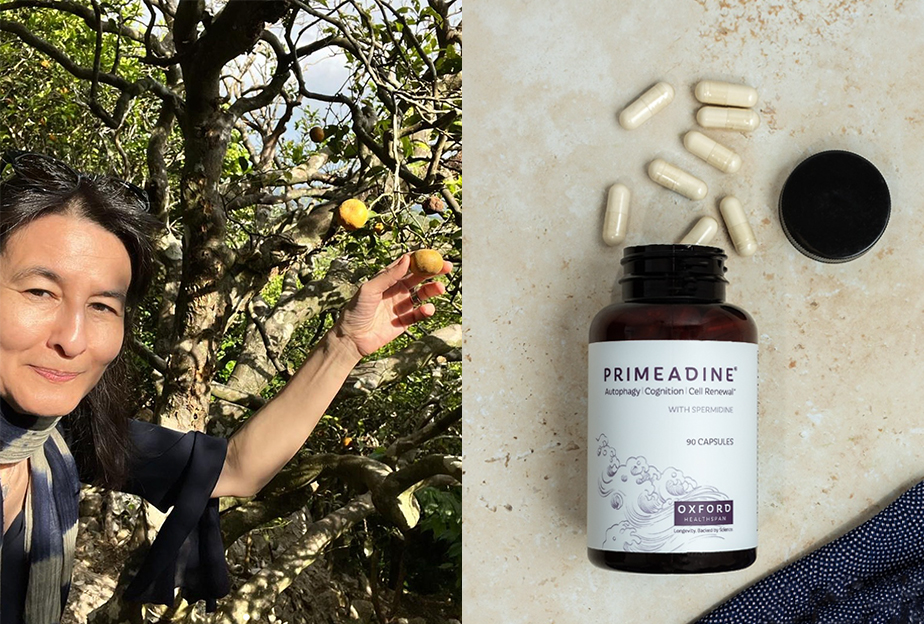
Leslie on a research trip to Japan, where she manufactures her supplement
“I launched during the lockdowns and I did ponder the timing. I thought, I’m about to press play on this, putting my own money at risk and I can’t sell in any shops. I didn’t know if it was the right thing to do. Plus I’d had over a decade out of business – I’d been raising my daughters, doing the school run. I was confident in my abilities but I was a realist and knew how people would think: ‘She’s taken time out to be a mum and she doesn’t have a lot of recent experience.’
“But I decided to go for it following my conversations with Professor Katja Simon [an Oxford University rheumatology expert who researches spermidine and is now an advisor to Primeadine], who encouraged me. With no shops open, I launched with a direct-to-consumer model [selling via their own website] and it worked.”
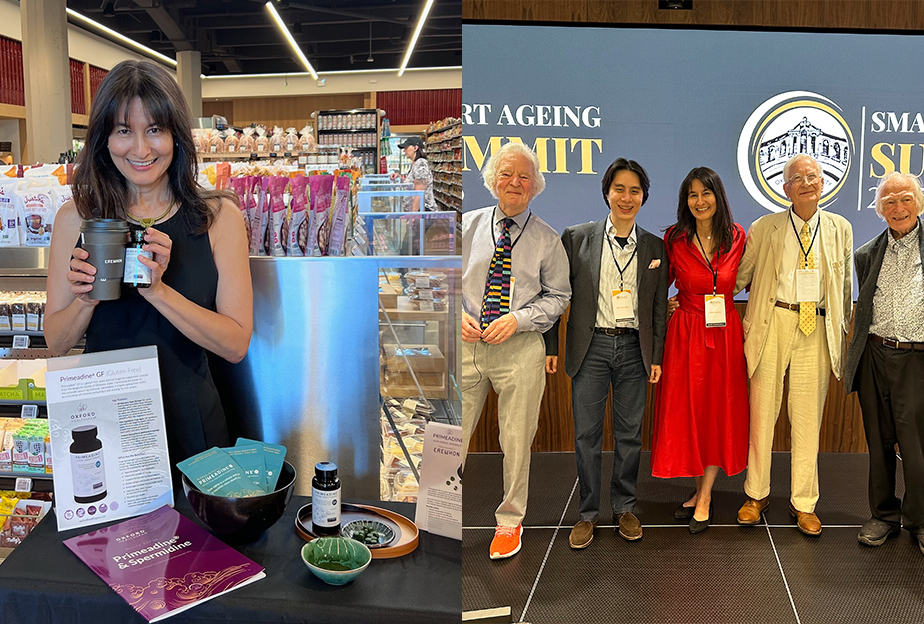
Leslie at US healthy grocery store Erewhon where Primeadine is now stocked and (right) at 2025’s Smart Ageing Summit, with her Oxford Longevity Project co-founders
“I frontload my day with the hardest tasks – the ‘eat the frog’ theory. I do my best work first thing when I’m fresh and I’ve had my coffee. I rarely schedule meetings early on because mornings are my deep thinking time.
“Our team of eight women are based across the world so we have most of our meetings on Zoom. Sitting for too long staring at a screen obviously isn’t great for health or productivity, so I’ve introduced this ritual where we stop the meeting after a while and everyone does some squats. At first people were like, ‘Er…’ but now they go along with it. They can do them off camera if they prefer! As the founder, I really want to walk the walk when it comes to looking after everyone’s health.
“I’m a very peppy, energised person, much to my youngest daughter’s disgust sometimes! But this comes from finding my purpose in life. Do not underestimate the power of this – you need to work out what your personal mission is. Work doesn’t feel like a grind to me because I am clear on my mission, which is to give every person an extra 10 years of healthy life.”
“I cried yesterday, when I was thinking about my late grandmother. I’m writing a book about longevity and was covering how I nursed her during the last year of her life, when she had a brain tumour. I was a student in California at the time, and I dropped out of university and went back to Indianapolis to care for her. We had a very special relationship. By the end she couldn’t move and all she could do was squeeze my hand. I would sit and read to her for hours. It was a real honour. That experience made me think a lot about the quality of our lives as we age.”
“Being an all-female team, many of us have responsibilities outside of work. We work flexibly around core meetings.
“I like getting up early and making things happen – yesterday I got up at 6.30am to work on the book. I try to mark sunrise and sunset each day by looking at the sky. I open up the French doors at the back of my house first thing, and let the sunlight (well, hopefully!) stream in. This helps reset my melatonin levels so I sleep well. Then I look at the sky again at sunset and see it as marking the end of the day and time to wind down.”
“I have little breaks through the day to use my FeetUp Trainer, £239. It’s a stool device that allows me to safely do a headstand, without putting any weight on my shoulders or neck, which can cause injury. It makes me feel like I’m taking myself out of the chaos of the working day. It gets blood to my brain and it activates the vagus nerve, which helps with stress. And because balancing requires so much focus, you can’t think about anything else for a few minutes.”

Getting out in nature and (right) casually popping out a headstand in Oxford city centre
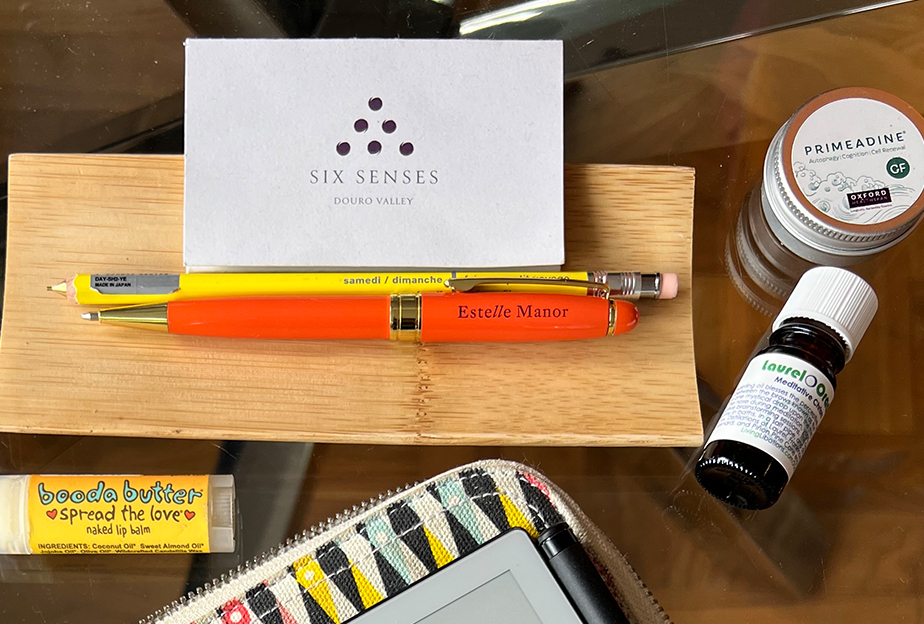
“Booda Butter lip balm, £3 and Living Libations Jasmine Grandiflorum essential oil, £54.94, which lifts my mood every time I put it on.”
“Something I learned from [US professor and wellbeing author] Brené Brown is when someone tells us something or we tell ourselves something, we should always then ask, ‘Is that really true?’ Is it a fact or just an opinion? It’s very useful when people tell you that you can’t do things or that they won’t work. And when the doctor told me I only had five years of good health left that certainly turned out not to be true.”
Primeadine costs £75 for a 1 month supply; Oxford Longevity Project