How healthy is your liver? Now there’s a lunchtime liver scan that’ll tell you

We associate liver disease with heavy drinking but doctors say stress, menopause and UPFs are to blame for rocketing rates. Our writer tried a new lunchtime liver scan – because liver health is the new gut health.
If you think about everything our liver does – hormone regulation, metabolism, detox, to name just a few of its jobs – it’s crazy that it doesn’t receive the same love as, say, our gut health does.
While you might be taking care to eat 30 plants per week, start your day with electrolytes or creatine and mainline medicinal mushrooms, you probably haven’t given your liver – the body’s main metabolic processing factory – a second thought. Big mistake – non-alcoholic fatty liver disease (NAFLD, ie where alcohol is not the cause) is on the rise, even among people who consider themselves to have healthy lifestyles.
The contributing factors such as stress, menopause, and sleep might surprise you. Which is why I – a healthy eater and imbiber of almost no alcohol, but a stressed-out menopausal insomniac – booked in for a new ‘lunchtime’ liver test, more of which below.
Your liver is your protector: like a nightclub bouncer for your body, nothing gets past it and into your bloodstream without good reason. None of the nutrition from your food will get absorbed and distributed efficiently unless your liver has processed it first. Your liver filters out toxins such as metabolic waste, alcohol and harmful environmental chemicals, and it regulates your hormones as well as your metabolism. If these processes don’t function well, you can experience everything from bloating to brain fog to even liver disease.
With such a roll-call of essential functions, you can see why a liver in great shape is key to a body and mind that work and feel at their best. And yet instances of liver cancer and non-alcoholic fatty liver disease (liver disease not caused by heavy drinking) are steeply rising. Liver cancer (which is linked to a fatty liver) is now the fastest-growing cancer in the UK. One in five of us have NAFLD, says British Liver Trust with rates increasing in step with rising obesity and type two diabetes. “Among people in middle-age and above, the estimate is that as many as 50 per cent have some fatty deposits on the liver,” says nutritionist Dr Federica Amati, who is chief medical officer at The Liver Clinic, a global chain of liver health clinics offering private liver scans and a liver health tonic called Deliverance.“The increase is really rapid.” According to one study, 38 per cent of people globally have a fatty liver, an early stage in many types of fatty liver disease.
We don’t need to tell you that alcohol and recreational drugs are silent assassins for your liver. But there are other culprits to be aware of, according to Amati and Siggi Clavian, founder and CEO of The Liver Clinic.
Avoiding fatty liver is key but it’s hard to detect. “Most people don’t find out until they’re in advanced stages of liver failure, which is a tragedy because NAFLD is entirely reversible with relatively simple lifestyle and diet changes,” says Dr Amati. But that could all change thanks to a new lunchtime liver test called Fibroscan, wich is being rolled out in clinics around the country. I tried the service at The Liver Clinic at central London pharmacy and health centre John Bell & Croyden.
Fibroscan is a five-minute, painless and non-invasive liver test that’s long been used by the NHS, but only on patients with advanced liver disease. The irony is that Fibroscan is actually best-placed as a preventative test to catch liver issues at a very early stage, that way giving you a real chance to fix your liver or avoid issues altogether.
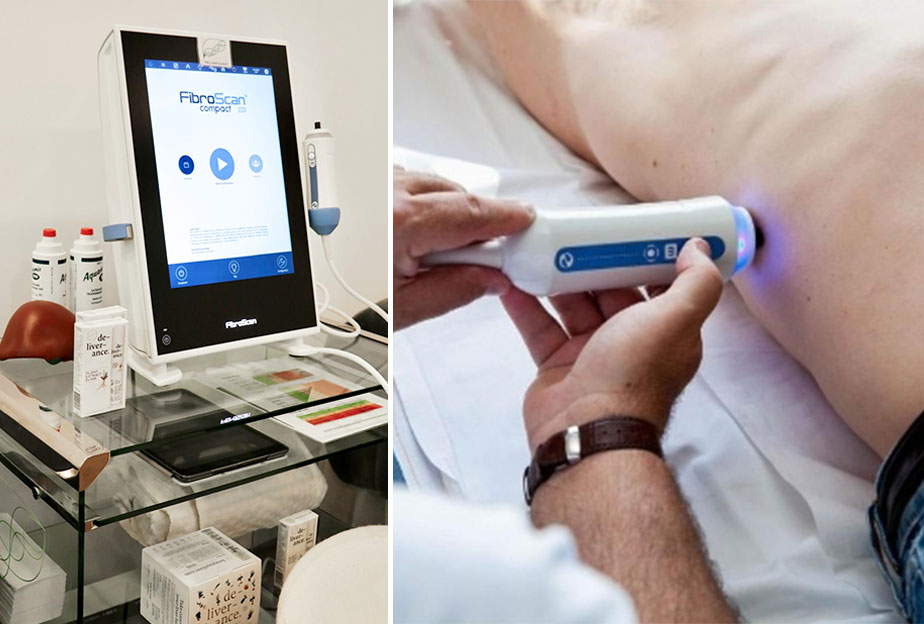
Five minutes and you’re done: the Fibroscan test is quick and painless.
The specialised ultrasound test, executed by a trained technician (in my case a nutrition consultant) gives a readout of your liver health in minutes, without the need for a blood test. Hilariously, the machine was developed for cheese makers who needed a way to determine how hard their wheels of cheese were in the centre; a clever clogs then realised the technology could be used in medicine.
“I have referred patients for the Fibroscan when their liver function test has come back abnormal but also after diagnosing high cholesterol,” says hormone and integrative doctor Sohere Roked. “If you think you have risk factors, Fibroscan can definitely be useful in terms of monitoring what is going on with your liver.”
This test certainly is quick and, on the face of it, simple. I answered some lifestyle questions, after which my technician applied gel to my abdomen then passed a buzzing probe emitting painless high-frequency sound waves over the liver area for a minute or three.
The sound waves give a reading of the liver’s ‘bounce’: a healthy liver, like your skin, is springy, but a fibrous (or stiff) liver means there is scar tissue. That’s a sign of a liver that is overloaded and inflamed. The test also determines what percentage of your liver is made up of fatty deposits: too much fat wears the liver down and impairs its function.
Your results place you in one of five risk-level zones; the worse your score, the more risk of unpleasant metabolic diseases such as type two diabetes and stroke. Not pleasant to hear, but the point of an elective Fibroscan is to help prevent early signs of liver damage turning into full-blown liver and other diseases.
My technician took just minutes to produce a number of readings that put my liver in the NAFLD-free ‘green’ zone; super-spongy and fat-free. Pat on the back for me. I was sent away with basic lifestyle and nutrition advice, but those with more cause for concern can get nutrition advice and referrals. A copy of your scores can be sent to your GP. It costs £299 at The Liver Clinic.
Fibroscan should be used primarily as a screening and preventative tool, says Amati, but it can also be helpful to determine if persistent vague symptoms are potentially due to a struggling liver. “You could have trouble maintaining your weight, high cortisol levels, bad fatigue, brain fog, itchy skin, a swollen tummy, shortness of breath – all these things mean it’s worth making sure that your liver is in a good place,” says Amati.
Clavian notes that many women book in their middle-aged husbands with expanding tummies for a Fibroscan. But you don’t have to be overweight: “As you approach your 50s and 60s and have a life that’s chronically stressful, that’s where your liver will really start to show signs of struggling,” says Amati. It’s why she advises most of her clients over 45 to have the test.
In fact, stress can be a red flag even if you’re young: “I sent a client in his early thirties in a really high-stress job, but fit and on a very balanced diet, for the scan. He turned out to have significant fatty deposits on his liver,” says Amati. “They were purely caused by stress.”
If your signs are more than vague (jaundice, chronic excessive water retention, upper abdominal pain) and you suspect you may already have liver disease, you should see you GP as soon as possible for bloods and further tests.
“A liver blood test will provide a comprehensive overview of the underlying cause of any liver disease, such as infections or cancer cells,” says Clavian. “But it does not identify a fatty liver or liver stiffness, which are the big warning signs that even more serious liver disease could be developing,”
Fatty liver disease is not detected in a whopping 90 per cent of people who have a liver blood test, he adds.
Clavian says that depending on the severity of it, you may be referred for an MRI, but this is rare. The advice after a concerning score is to speak to a nutritionist to look into your diet, as adjusting it can reverse your liver fat and stiffness.

These are some of the liver-friendly habit changes our experts recommend.
Fibroscan is available nationwide at private clinics such as The Liver Clinic, Randox Health and Welbeck, with prices ranging from about £200 to £600